
Certerra Subsurface Liner Leak Location – Pinpointing industrial pond liner leaks
News2 Mar 2026
Hammer drilling uses percussive force delivered to the bit, typically with a down-the-hole hammer (DTHH), to fracture and advance through hard rock and dense formations. Its efficient energy transfer supports deeper, straighter boreholes in challenging geology.
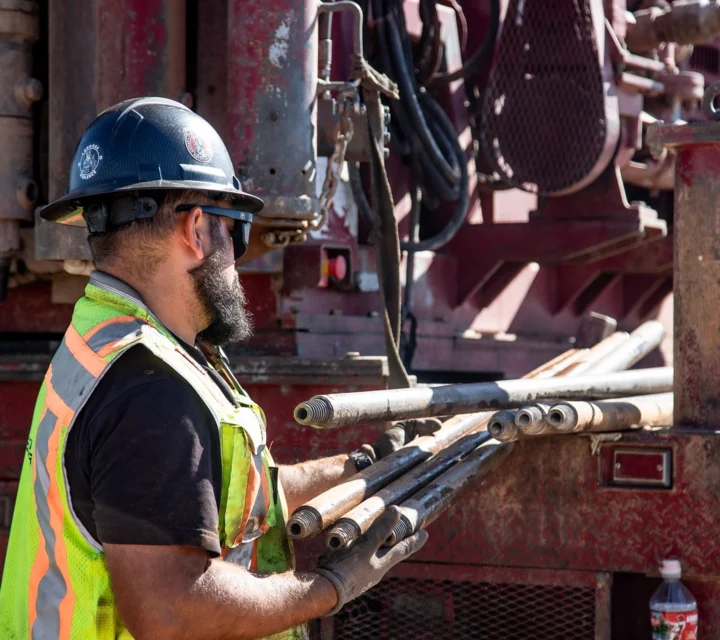
In hammer (DTHH) drilling, a pneumatically-powered hammer situated just above the bit delivers rapid impacts directly against the rock face, breaking it into cuttings while the drill string rotates and advances. Compressed air drives a piston that repeatedly strikes an anvil linked to the bit, minimizing energy loss compared to surface-percussive systems and improving penetration especially in hard rock. Cuttings and dust are typically flushed from the borehole by the same air stream.
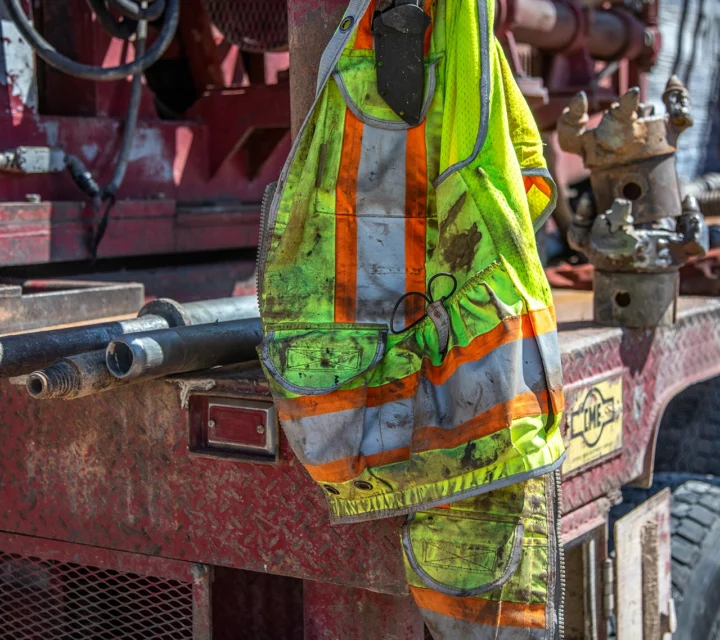
Hammer drilling is widely applied where hard rock penetration is required, including deep water well drilling, foundation drilling, and geotechnical investigations through dense formations. Its efficiency and straight hole performance also support monitoring well installation, construction piling, and other subsurface access in medium-hard to hard rock contexts.
Learn more about our operational principles of hammer drilling, typical project applications, and common considerations for method selection and performance in environmental and geotechnical contexts.
Hammer drilling uses a down-hole percussion hammer that delivers energy directly at the bit, resulting in greater penetration efficiency in rock compared to surface percussion or traditional rotary drilling.
It’s preferred for drilling through hard rock or dense formations where high impact energy and consistent cut fragmentation are needed, including deeper boreholes and applications requiring straight hole alignment.
Compressed air (or occasionally water or other fluids) is circulated down the drill string and up the annulus, flushing cuttings from the hole while also powering the hammer action.
Factors include air pressure/volume capacity, bit selection, formation hardness, and vibration/noise constraints, especially when drilling near sensitive infrastructure or in urban environments.
Hammer drilling is well suited for penetrating hard and competent materials where other methods are limited. Field-executed hammer drilling provides efficient rock advancement and clear documentation to support investigation and installation decisions.
Loading...