Certerra Subsurface Liner Leak Location – Pinpointing industrial pond liner leaks
News2 Mar 2026
Rotary drilling uses a rotating drill bit and drill string to advance boreholes through soil and rock. Circulated fluid or air removes cuttings and supports borehole stability, making it suitable for deeper subsurface investigations and installations where geology varies.
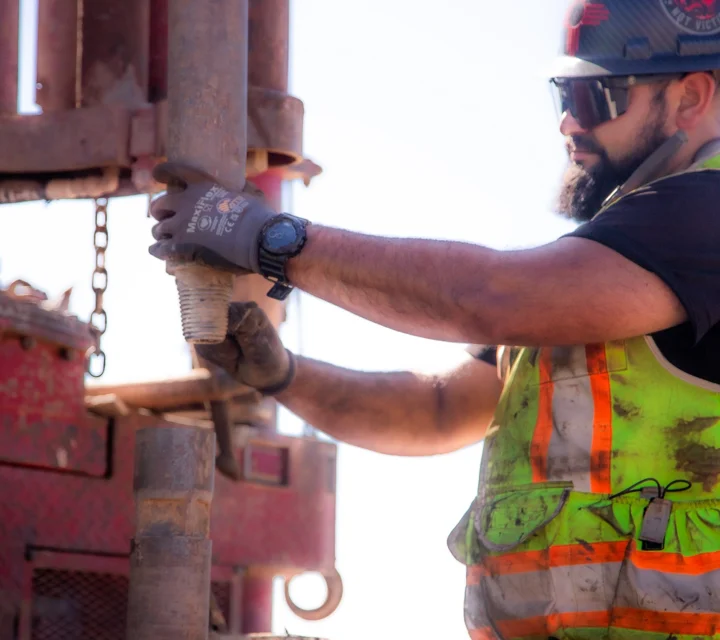
Rotary drilling techniques apply continuous rotation and downward force to a drill bit mounted on a string of drill pipe. As the bit cuts or grinds the formation, drilling fluid (mud) or compressed air circulates down the drill string and back up the annulus to carry cuttings to the surface and help stabilize the borehole. Variations such as air rotary, mud rotary, and dual rotary allow adaptation to different subsurface conditions and project needs. Borehole casing may be advanced concurrently in unstable formations to help maintain hole integrity.
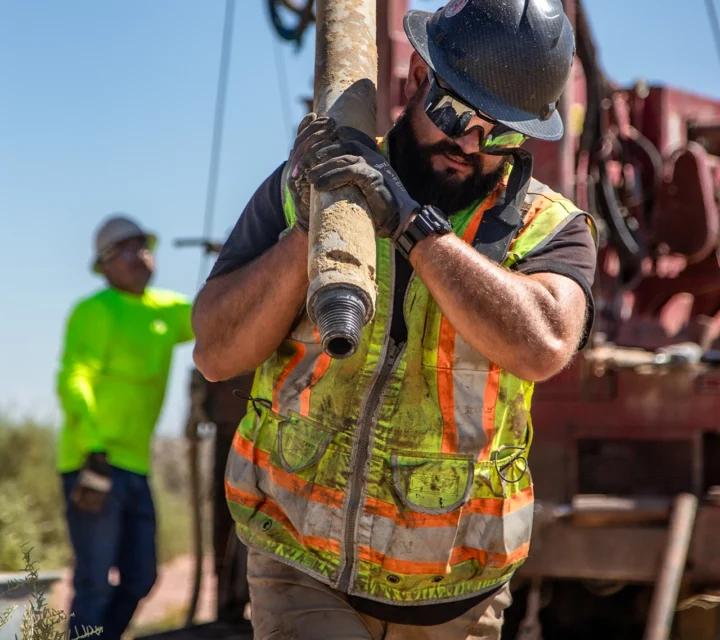
Rotary drilling is widely used where deeper subsurface access and borehole stability are required. It supports geotechnical soil and rock investigation, installation of monitoring and extraction wells, and other deeper boreholes in variable geology.
Learn more about rotary drilling, including operational principles, when it’s appropriate, key variations, and considerations for environmental and geotechnical site investigations.
Rotary drilling is used to advance boreholes through a wide range of ground conditions, supporting deeper geotechnical investigations, installation of wells or monitoring points, and other subsurface access where significant depth or variable geology exists.
Cuttings are removed by circulating drilling fluid (mud) or compressed air down the drill string and back up the annulus, carrying the cuttings to the surface and helping to stabilize the borehole walls during advancement.
Common rotary variations include air rotary for hard, dry formations, mud rotary for unstable soils, and dual rotary for unconsolidated ground with casing advancement for improved sample quality.
Planners should evaluate formation competence, depth and diameter requirements, fluid handling and cuttings management, borehole stability needs, and sampling objectives to match the appropriate rotary variant to site conditions.
Rotary drilling supports deeper subsurface access where varying materials are present. Field-executed rotary drilling provides controlled penetration and clear documentation to support investigation, sampling, and informed subsurface decision-making.
Loading...