Certerra Subsurface Liner Leak Location – Pinpointing industrial pond liner leaks
News2 Mar 2026
Certerra applies its geophysical and hydrogeological characterization technologies to investigate how fluid moves through large engineered rock piles, diagnosing pathways of preferential flow and channeling within the mass. It identifies zones of varying permeability, influenced by factors such as stacking, material compaction and particle-size distributions, for example where fine-grained material accumulates near the surface or where coarse boulders dominate the structure.

Certerra’s approach monitors internal heterogeneities by connecting fluid movement with structural attributes of the pile. Our technology examines how permeability, dumping practices and material-treatment history control the leachate path, and how zones of low permeability may cause bypassing of large volumes by more accessible regions of higher permeability. By imaging the resistivity variations in three-dimensions, the system reveals wet vs dry zones, enabling inference about moisture distribution and flow pathways deep inside the structure.
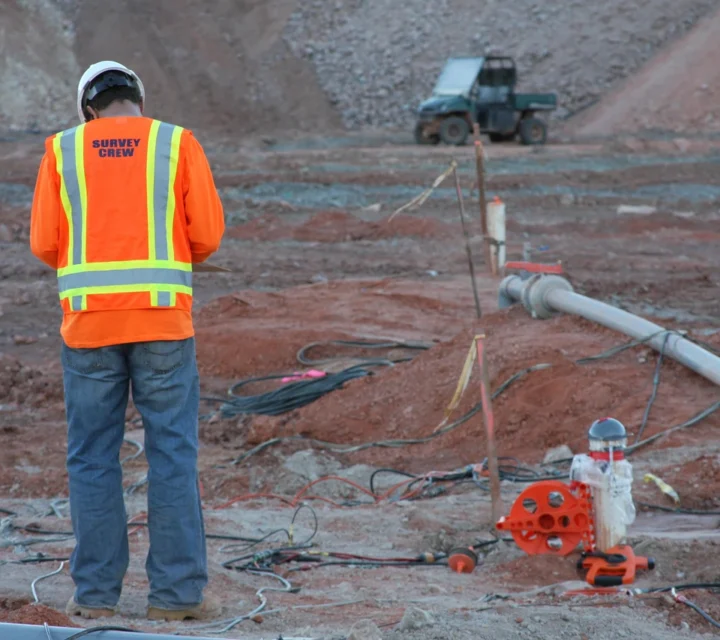
The characterization technology addresses the challenge of significant metal mass remaining uncontacted by leachate due to complex conditions that affect flow. When fluid travels preferentially through high-permeability channels, large volumes of material remain under-treated in low-permeability zones. This hidden inventory poses forecasting, recovery-efficiency and operational-risk issues. By bringing visibility to structural non-uniformity, flow channeling and compaction effects, the approach offers a way to diagnose where fluid dynamics reduce performance.
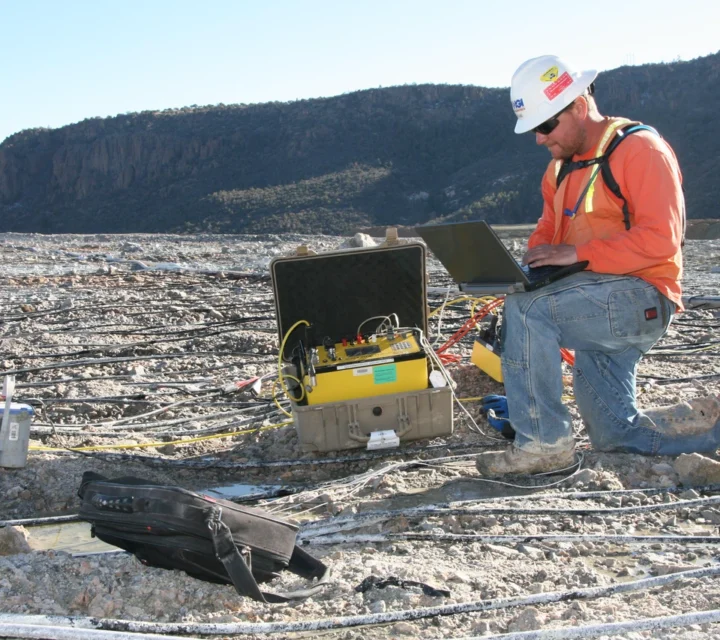
Our clients receive insight into the internal distribution of moisture and fluid pathways within the pile, enabling improved prediction, design, or management of the system. By visualizing zones of dry and wet material, the technology supports decisions that enhance contact, optimize fluid delivery and recover otherwise untapped mass. The result: a clearer understanding of how the system behaves, enabling improved operational strategies and better alignment of fluid-delivery with the physical reality of the structure.
We use multiple geophysical methods to image leach pads, each providing unique insight into internal hydraulic conditions. Each method offers different scale and resolution capabilities, so we tailor the approach to match your project objectives and operational requirements.
Electrical resistivity measures variations in subsurface electrical properties to reveal differences in general moisture conditions.
Similar to electrical resistivity, but can measure electrical properties at greater depths over difficult terrain (e.g., side slopes)
BMR measures the nuclear spin of hydrogen along a PVC or open well. The data provides precise measurements of clay bound, immobile, and mobile water content.
Get the facts about mapping leach pads—how it works, why it matters, and how advanced subsurface imaging helps understand fluid movement, optimize recovery, and support safer, more predictable heap performance.
Geophysical characterization can expose preferential flow paths, compaction zones, dry regions, or perched moisture zones—conditions that influence solution contact, drainage efficiency, and recovery rates.
A heterogeneous permeability distribution allows the solution to travel through a few efficient channels, bypassing large regions of the pile. Identifying these variations helps correct imbalances that limit leach effectiveness.
It generates a detailed picture of internal moisture and structural conditions as interpreted from the geophysical data, enabling predictive modeling and supporting operational adjustments to enhance efficiency and recovery performance.
The insights gained enable better fluid management, improved recovery, reduced uncertainty, and safer operation—ultimately increasing the economic and environmental value of the asset.
Heap leach performance depends on internal conditions that are difficult to observe directly. Heap leach characterization provides field-verified insight into subsurface variability to support monitoring strategies, planning, and informed operational decisions.
Loading...